Last week I watched my sixteen-year-old carefully label his lab drawing. I stood behind him and smiled because I've seen that same careful hand before, when he was eight years old, meticulously sketching skunks (check out that drawing below).
After over a decade of Charlotte Mason-inspired homeschooling, I truly believe children are born persons AND scientists.
In our family, nature journaling started as a few minutes in our backyard or at our breakfast table and a sketch of a simple leaf or whatever bird showed up at our feeder that day.
Years later, as our children have grown into formal science curriculum and challenging lab work, I've been surprised by how much of that early habit carried through…
The child who learned to draw a feather slowly and carefully is the same child who now records meticulous lab observations.
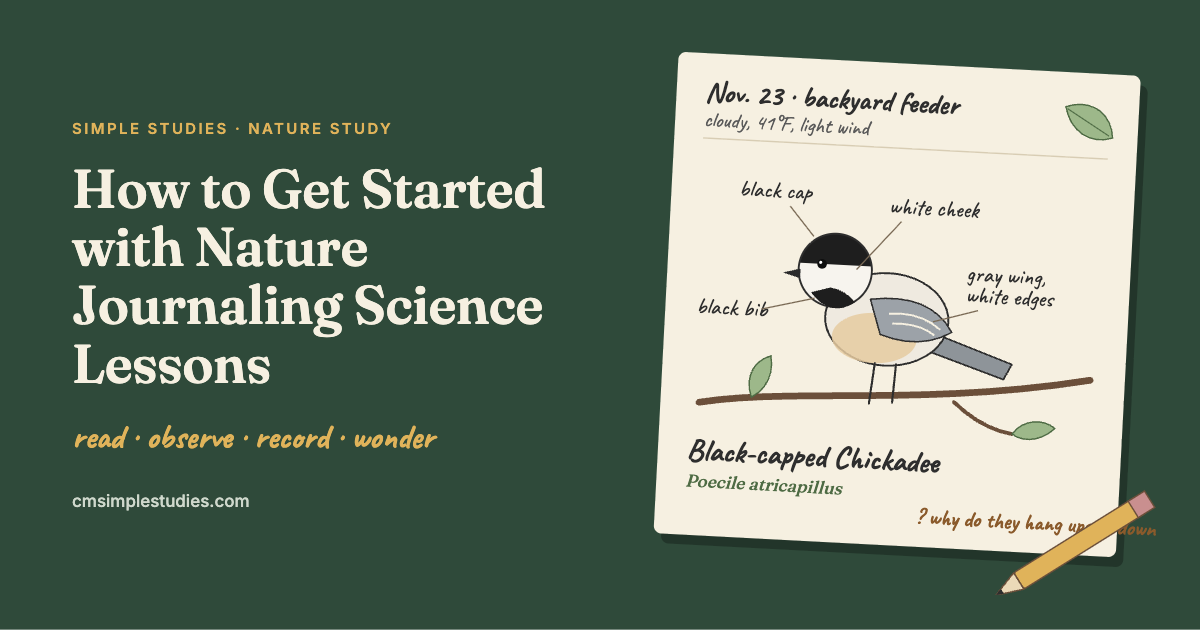
Here's how to get started with nature journaling science lessons, even if you've never kept a journal yourself.
What nature journaling science lessons actually are
A nature journal is a notebook where a child records what they observe in the natural world: drawings, labels, dates, weather, questions, and a few words about what they noticed. It isn't an art class, and it isn't a worksheet. It's a record of real looking.
When you pair that journal with a short, living lesson (a chapter from a classic nature book, a bit of discussion, and a field guide), it becomes a science lesson. Your child hears about the red-winged blackbird, goes looking for one, sketches what they find, and checks the field guide to compare. That's the scientific method in its gentlest form: read, observe, record, wonder.
Charlotte Mason believed this kind of first-hand observation was the true foundation of science, and that children who learned to love and notice nature early would come to formal science with both knowledge and appetite.
Why it prepares kids for formal science and labs
This is the part I wish someone had told me when our kids were little. Nature journaling isn't just a sweet extra for the early years; it quietly builds the habits a science or lab class demands later:
Careful observation. Drawing forces a child to look at proportion, color, and detail.
Accurate recording. Dates, locations, weather, and labels become second nature. In a lab notebook, that same habit is non-negotiable.
Classification. Using a field guide teaches kids to sort living things by features, and introducing Latin names early makes biology vocabulary far less intimidating later.
Asking good questions. "Why does this leaf have holes?" is the seed of every later hypothesis.
Patience and attention. Sitting still long enough to watch a pond skater is excellent training for waiting on an experiment.
By the time our older children opened formal science textbooks, they weren't starting from zero. They were filling in the "why" behind years of things they'd already seen with their own eyes.
What you need to get started
Keep it simple. You truly only need:
A sturdy notebook. Mixed-media or watercolor paper holds up best, but any blank sketchbook works.
A few good pencils and, if you like, colored pencils or a small watercolor set.
A regional field guide for birds, insects, or wildflowers.
A living book to spark interest: a classic nature story your children will actually look forward to. (Simple Studies guides offer great places to start).
A few minutes, a few times a week. Ten to fifteen minutes is plenty for young children.
That's it. No elaborate kits, no expensive curriculum boxes, no major science experiments at very young ages…
A simple rhythm: read, observe, record
Here is the rhythm we've used for years, and it's the same rhythm built into every Simple Study.
1. Read a short living lesson. Start with one chapter of a classic nature lore book. These stories introduce real animals and real behaviors through characters children love, so the facts stick.
2. Narrate and discuss. Ask your child to tell back what they heard. A few simple discussion questions help them connect the story to what's true about the creature.
3. Go look. Head to the backyard, a park, a pond, or even a window. Look for the creature you read about, or anything else that catches your eye.
4. Record it. Sketch it, label what you can, and add the date, place, and weather. Younger children can color a picture of the animal from the lesson instead. That counts!
5. Dig deeper (for older kids). Check the field guide, look up the Latin name, note the habitat or range, and write down one question to explore.
Done a few times a week, this little rhythm grows into a real body of scientific knowledge, and a journal your children will treasure.
Simple Studies that pair beautifully with a nature journal
I originally created Simple Studies so I could fold nature study into our mornings at the table without a lot of prep. Each one follows a classic living book, chapter by chapter, with narration prompts, discussion questions, picture book lists, field guide recommendations, and Handbook of Nature Study guidance. Younger children get hand-drawn coloring pages, while older students are nudged toward field guides and their nature journals. Here are the ones our family has loved most for nature journaling.
Start here: Burgess Birds
If you're not sure where to begin, begin with birds. They're everywhere, they're easy to watch from a window, and children fall in love with them quickly. Burgess Birds: A Simple Studies Guide follows The Burgess Bird Book for Children with 45 short lessons (about 10–15 minutes each), plus optional nature journaling prompts, Latin naming and migratory mapping prompts for older students, bird poetry, and a suggested schedule for the year. It's a wonderful first "living science" year.
For insect and wildflower lovers: Meadow Creatures
Simple Studies: Meadow Creatures walks through Among the Meadow People by Clara Dillingham Pierson in 28 lessons. It includes insect life cycle watercolor illustrations, which are perfect models for children learning to draw and label stages of metamorphosis in their own journals.
For hands-on explorers: Pond Creatures
Nothing beats a pond for curious kids. Simple Studies: Pond Creatures follows Among the Pond People in 18 lessons and includes animal species pictures specifically for nature drawing, plus two optional final projects, a great first taste of a longer science project.
Keep the journal going all year
Once your children are in the habit, these studies keep the pages filling:
Simple Studies: Forest Creatures: woodland animals for walks among the trees.
Simple Studies: Night Creatures: owls, moths, skunks and other animals of dusk; a fun excuse for an evening nature walk.
Simple Studies: Learning North American Animals with Thornton Burgess: a wider look at the mammals of our continent.
Simple Studies: Learning Seashore Animals with Thornton Burgess: ideal for tide-pool trips and beach vacations.
Simple Studies: Farmyard Animals: a gentle first study for your youngest learners.
Tips for making it stick
Don't grade the art. The goal is honest observation, not a pretty picture. A wobbly sketch with three careful labels is a scientific success.
Journal alongside them. Children journal more when they see you doing it too.
Keep the journal by the door. Easy access means more spontaneous entries.
Revisit old pages. Flip back a season and compare. "The maple was green in September. What changed?"
Let older kids lead. As they grow, hand them the field guide and the questions. For us, when we see something, we’ll race to the field guide to identify what we witnessed in the wild. You'll be amazed how naturally journaling becomes lab-notebook thinking.
Start small this week
You don't need a perfect plan. Read one chapter, and spend ten minutes outside looking for something to draw. Sketch what you see, write the date, and you've started!
If you'd like the lessons, booklists, and prompts laid out for you, Burgess Birds is the easiest place to begin and follows Ambleside Online’s Charlotte Mason recommendation for nature lore. The habits your children build at the kitchen table today are the very ones they'll carry into the science lab tomorrow.
At least, that’s what’s worked really well for our older students.
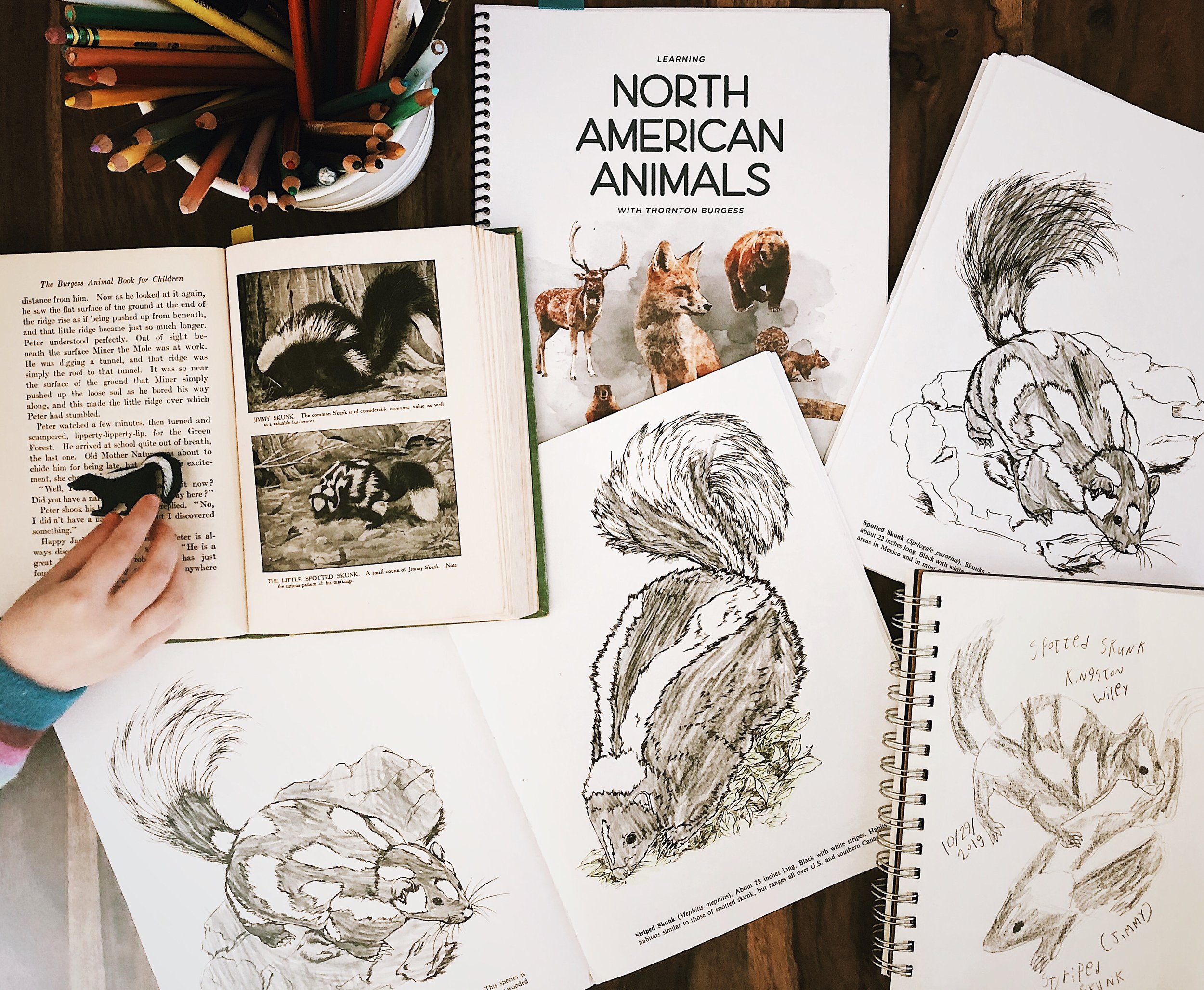
Image: When we read and nature-journaled our way through my first guide: Simple Studies: North American Animals
Happy journaling!
Crystal
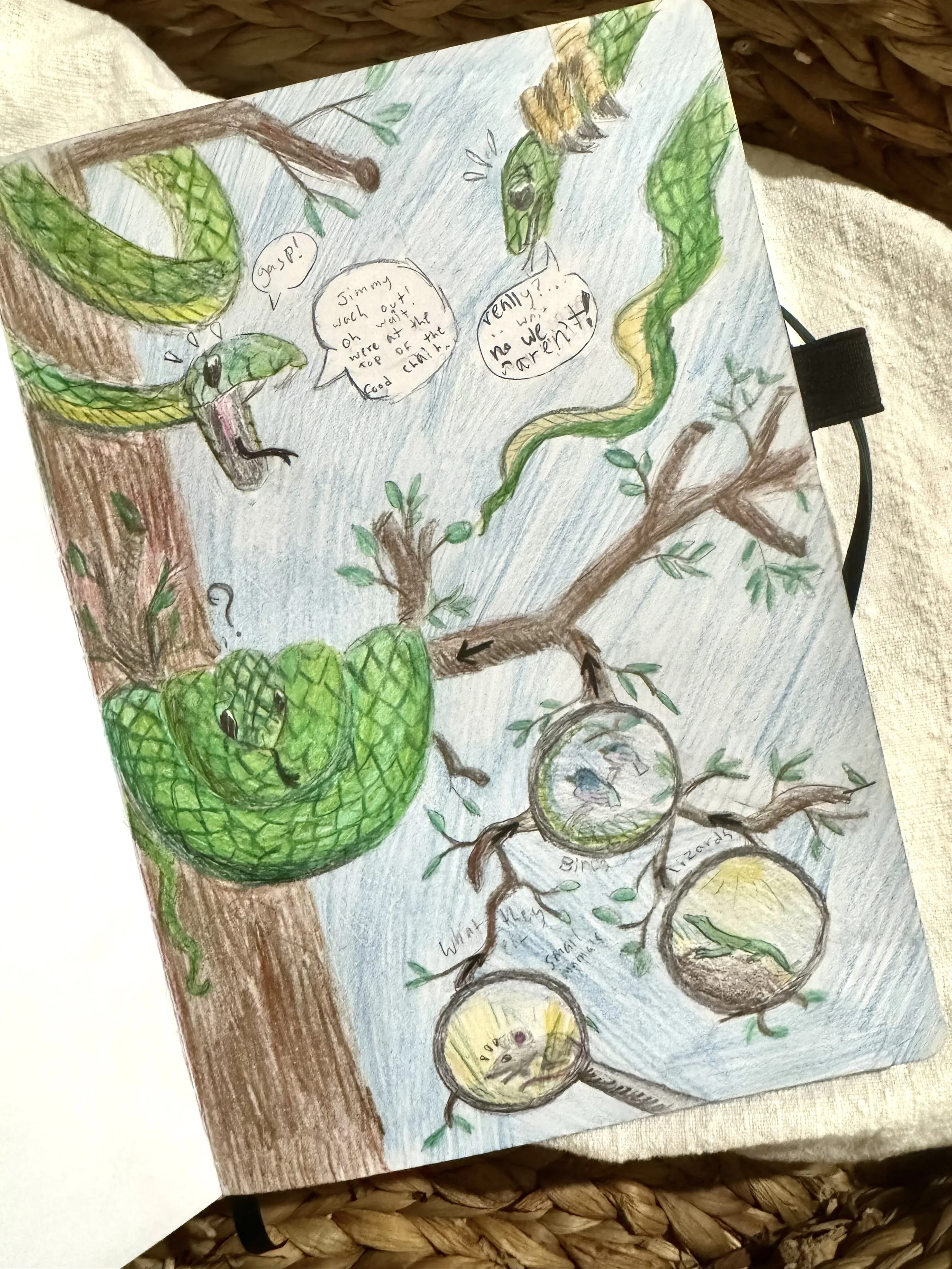
Those wobbly little sketches matter more than you think!
A simple, Charlotte Mason–inspired guide to starting nature journaling science lessons with kids, and how it builds the skills they'll need for formal science and labs.