"We have different gifts, according to the grace given to each of us." (Romans 12:6)
My youngest's handwriting changes depending on the subject she’s working on.
I didn't think much of it until last week and it confirmed something I've believed for a long time: that not every subject deserves the same time and weight on our homeschool table.
If you've ever felt the tension between "give every subject its due" and "lean into what lights your kid up," you might relate.
Our unique gifts aren't earned or chosen, they're given by grace, and they're meant to be different from person to person on purpose, because the body of Christ only functions when its parts play distinct roles rather than all trying to do the same thing…
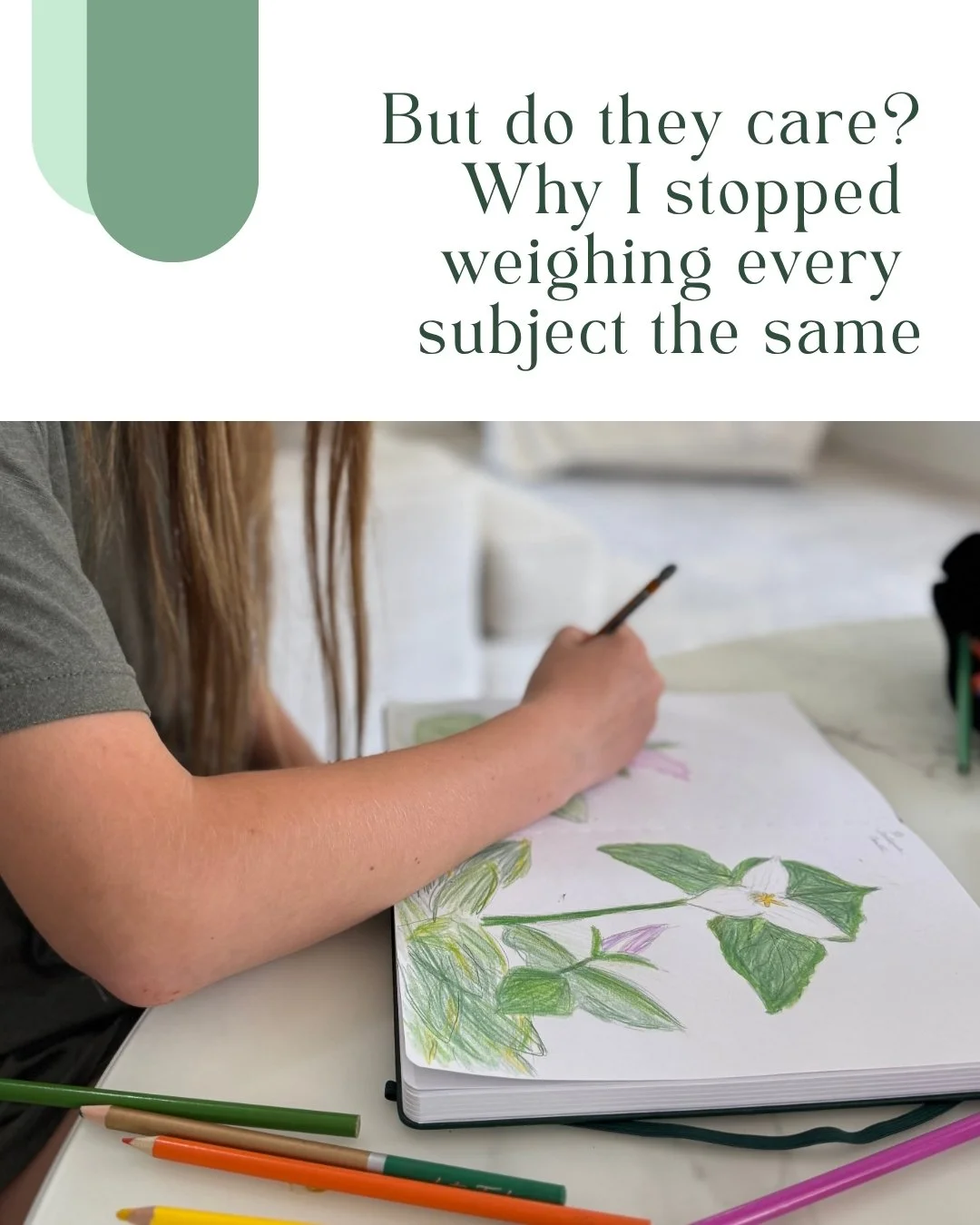
I was watching her move through her morning work: writing in her Commonplace book, sketching in her Nature Journal, adding little notes to her Shakespeare notebook, then working through Latin, Math, Geography, History, and a slew of other subjects.
And there it was, plain as day.
When she got to her Nature Journal, she painstakingly focused on her plant sketches.
When she started writing notes in her Commonplace book, she slowed down to get the spelling just right.
When she got to her Shakespeare Latin terms, she made sure her handwriting was better than usual.
But when she moved to her math lessons, her numbers got sloppy, her foot started bouncing under the table, and she was suddenly very interested in whatever was happening outside the window.
Same child. Same morning. Completely different level of care and interest.
And that’s when I felt the confirmation I already knew: She's working diligently on the topics she cares most deeply about and she's a tad frivolous with the topics she cares less about.
Naturally, I believe all subjects are created by God, so we should offer them all as a feast to our students.
But should all subject areas carry the same weight for each child?
Think about your dinner table, the one where somebody's crying about the chicken and someone else has already asked for seconds on carrots before touching their plate. You don't measure out identical portions and force everyone to finish.
You already know what each of your children is most likely to reach for.
Homeschooling can feel a lot like that table, except the "reaching for" is happening across subjects instead of food, and it's easy to feel like we're failing if every child's plate doesn't look the same.
You've probably heard the term delight-directed learning by now. It's everywhere in homeschool circles for a reason: it names something a lot of us already feel in our gut but were too afraid to act on, because we were taught that "well-rounded" means equal minutes on every subject, every day, for every child.
But equal isn't the same as adequate, and it definitely isn't the same as effective.
Here's what I mean. If one of my children could spend all afternoon in our music practice room and the other would rather spend that same hour buried in a novel or running laps outside, giving them identical schedules doesn't create balance.
It just means one of them is thriving and the other is quietly checking out, sometimes without either of us noticing until months later.
This is all to say, I've always believed in strength-based homeschooling. You've probably read plenty of my emails or articles on this topic already.
But if I can assure you of one thing, it's this: all our children were created uniquely and wonderfully by our God. And as sure as we are of the sun, mothers to multiples know just as surely that siblings are often created vastly different from one another. One may have an affinity for art, history or math, and the other might light up over music, writing or gymnastics.
So should we really be giving every subject the same weight and attention, for every child, all the time?
I’d argue we do not.

As our children get older, it becomes clearer how God wired their brains. Just because they love art doesn't mean we skip math. It might just mean art gets more of their time than math does.
Here's how that's looked for our children lately: my oldest loves coaching sports, math, history and forensic science, so those get more hours of his week than say classic novels and composition.
My youngest's Nature Journal and time for reading books she loves used to get twenty or thirty minutes. Now they receive as much time as she needs, and her math lessons are trimmed down to the basics she needs this year, nothing extra "just because."
I'm not chasing balance for balance's sake. I never have. I'm following and guiding them where they're already leaning in.
I'm not here to make sure my history-loving child crushes life in art and writing. And I'm not here to make sure my novel-loving child finishes every single math lesson.
What I am here to do is let my children unveil to me who God made them to be, and then help them hone in on their affinities, offering time and opportunities to explore those God-given gifts in deeper, more meaningful ways.
Call it delight-directed learning, strength-based learning or simply what I like to call it: homeschooling based on the way each child is uniquely, wonderfully, and fiercely created.
"For you formed my inward parts; you knitted me together in my mother's womb. I praise you, for I am fearfully and wonderfully made."
(Psalm 139:13-14)