There comes a point in your homeschool years when you realize the goal was never really about covering the material.
It was about preparing a person.
A person who can think, who can lead, who knows what they believe and why, and who can hold onto it when life gets hard.
My children are in the upper years of their homeschool education now, and I have felt, more than ever, the urgency of this season. The sweet years of picture books on the couch are behind us. These days, my teens work largely on their own. My role has shifted from teacher to mentor, and my job now is to launch them well.
But I did not want to get to launch day without having had the right conversations first.
The Main Questions…
Before they fully spread their wings, I wanted to make sure we wrestled with the big questions together. Not the questions on a test. The real ones.
What do you actually believe, and why do you believe it?
What ideas are worth keeping, and which ones deserve to be questioned?
What does it mean to be genuinely educated, not just credentialed?
What does it look like to live with integrity and grit when no one is watching? H
ow do you love your neighbor well in a world that has forgotten how?
How do you find work that is worth doing and do it with excellence?
How do you choose the people you will spend your life with?
What does God actually require of a person, and how do you build a life around that?
I looked around for a guide that took those questions seriously. Something that would give my teenagers the right books and give us the right conversations. Something rooted in the Charlotte Mason method and the classical tradition, but practical enough to actually use in a real homeschool with real teenagers.
I could not find exactly what I was looking for. So I created it.
What The Well-Read Teen Is
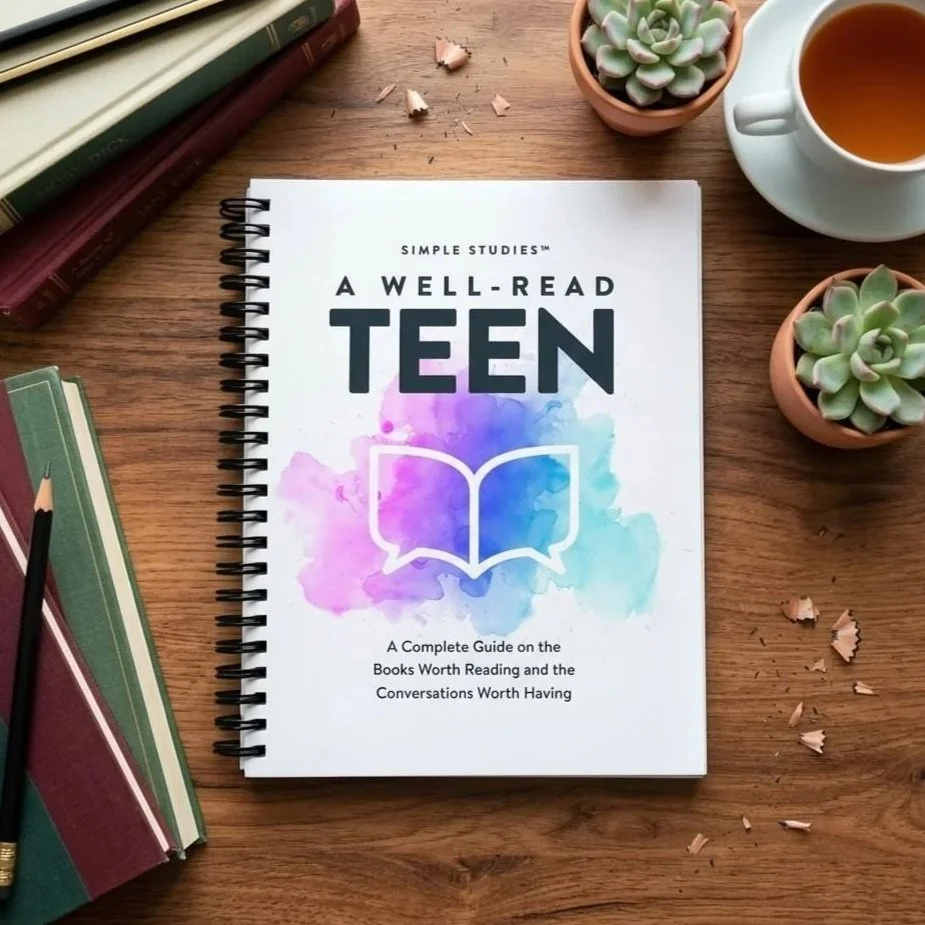
Simple Studies: A Well-Read Teen is a complete, 4-year reading and teaching guide for homeschool families in grades 7 through 12. It’s built around three educational traditions I deeply believe in: the Charlotte Mason method, Thomas Jefferson Education, and Classical Education. Each one brings something essential to the upper years.
Charlotte Mason believed that teens thrive on living books, real books written by people who lived deeply and thought carefully, not textbooks or summaries. She believed that narration, the simple act of telling back what you read in your own words, builds comprehension, memory, and communication in ways no worksheet ever could. Every lesson guide in A Well-Read Teen is built around that conviction.
Thomas Jefferson Education holds that the purpose of education is not to fill a student with information but to forge a leader. Learning is most powerful when it happens alongside great thinkers, through mentorship rather than instruction. The parent guided prompts in this curriculum reflect that. Your job is not to teach the book. It is to ask the questions, and listen more than you speak.
Classical Education grounds students in the timeless great ideas, great lives, and great texts of civilization. It asks not just what to think but how to think and how to live virtuously. The book lists in A Well-Read Teen reflects that tradition, from Homer to C.S. Lewis, alongside modern books that take the same questions seriously.
What Makes It Different
Most reading guides give you questions about the book. A Well-Read Teen gives you questions about your teen’s life.
Every lesson unit includes discussion prompts that go beyond comprehension and into conviction, narration prompts rooted in the Charlotte Mason method, a real-world application activity that takes the book’s ideas off the page and into your teen’s actual daily life, and a parent prompt designed to draw you into honest mentoring conversation with your teenager.
The book list itself is unlike anything I have seen in a homeschool curriculum. It covers nine categories including courage and survival, faith and apologetics, money and vocation, character and leadership, biography and history, books specifically for teen girls, creation and science, fiction, and classical knowledge.
It includes 16 books with full lesson guides and 57 additional curated reading recommendations, for a total library of over 70 books.
While this is a Christian guide at its heart, I did not choose overtly Christian books for every title. My assumption is that your teen is already reading many of those through what you assign at home. Instead, these books are meant to prepare your child for the world as it actually is, not as we wish it were, and to give them the wisdom to navigate it faithfully.
A Note on What This Guide Is Not
A Well-Read Teen is not a checklist. It is not designed to be completed from cover to cover in a single school year. It is designed to be lived in over the upper years, at whatever pace fits your family and your teen.
It is also not prescriptive. No one knows your child better than you do. Within each of the nine categories, I recommend choosing at least three books rather than attempting the full list. A teen who has thoughtfully engaged with three well-chosen books in a category will walk away far better equipped than one who has skimmed through all of them.
The goal is not a teen who has covered the material. It is a teen who has been changed by it.
Why Now
These years go fast. Faster than anyone tells you when you are still in the picture book season. The upper years are not the end of your homeschool. They are the climax of a hard-earned education. And the conversations you have in these years, around the right books, at the right table, will stay with your teenager long after they have left your home.
I prayed over this guide for years before it was finished. My prayer is that it gives your family the books worth reading and the conversations worth having, right on time.
Simple Studies: A Well-Read Teen is available now as a digital PDF download.