High School Spring Book Picks 2026/27

We're officially homeschooling our oldest again, and I am in joyful chaos mode curating high school curriculum, reading excellent books alongside him, and diving into the world of dual enrollment.

It’s all a HAPPY whirlwind!

For those who've been following our journey: our son still attends his private Baseball Academy six-plus hours a day, and they've graciously allowed him to continue homeschooling alongside that. We never know where the Lord will take our children, and that's exactly how we like it. We are so grateful to keep walking with him toward his academic AND athletic goals.

A few high school reads are listed below in no particular order.
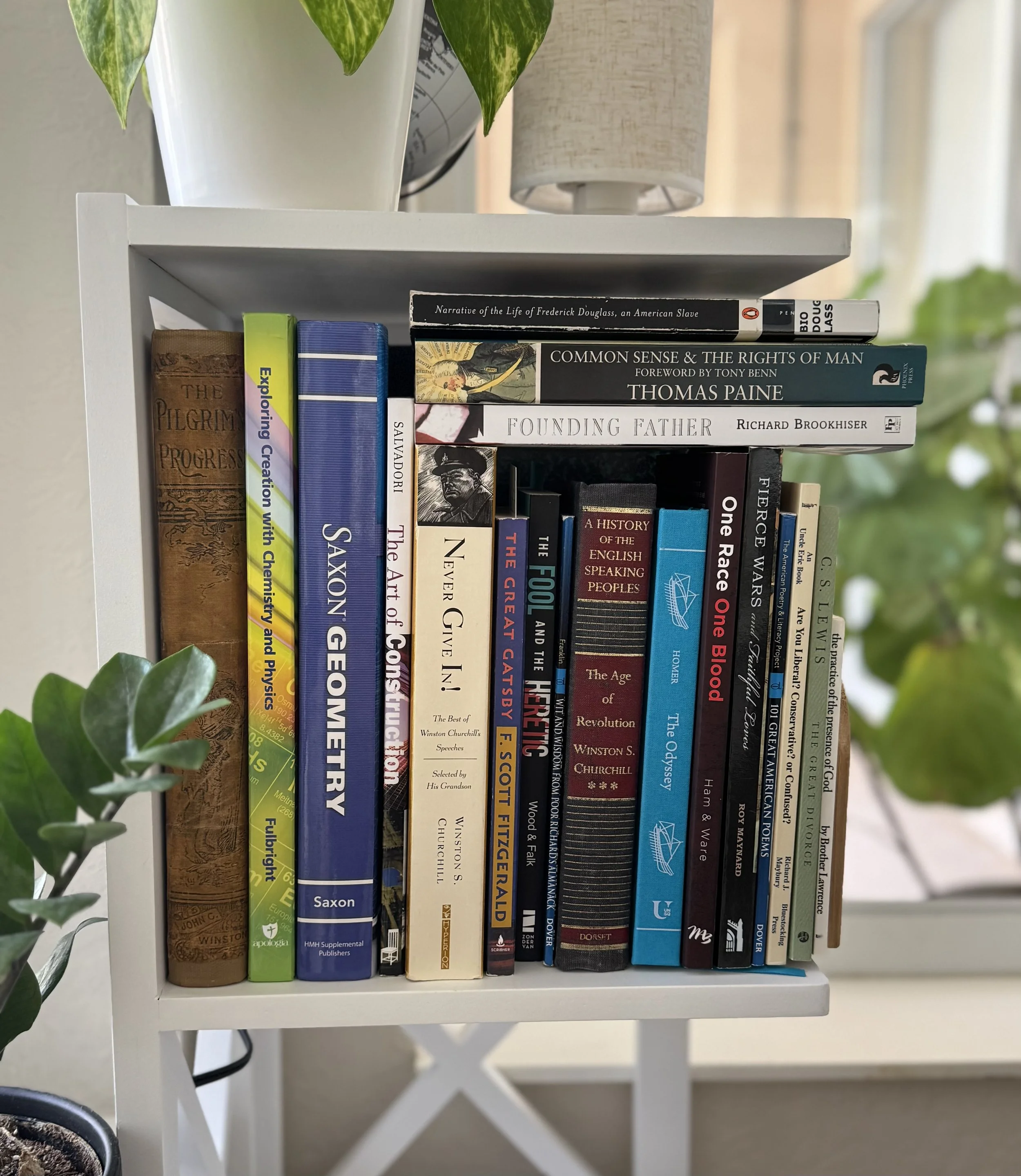
 

Many are read slowly together, some independently, all looped each week. We're using Ambleside Online and a mix of other living books and adding in a few reads, curriculum and video courses to round out his lessons. 

Are You Liberal? Conservative? or Confused? by Richard J. Maybury (We are working through the second half of my Simple Studies: Exploring Political Ideologies guide with this book since we put it down to move across the US last year!)

The Odyssey by Homer 

The Great Divorce by C.S. Lewis

Narrative of the Life of Frederick Douglass, an American Slave by Frederick Douglass

Common Sense & The Rights of Man by Thomas Paine

Founding Father: Rediscovering George Washington by Richard Brookhiser

The Pilgrim's Progress by John Bunyan (He’s reading one of our beautiful, illustrated versions printed in the 1800s)

Chemistry (We own the Apologia books both early and high school but are supplementing with various other videos and curricula)

Saxon Geometry

The Art of Construction by Salvadori 

Never Give In! The Best of Winston Churchill's Speeches by Winston Churchill (we are reading this aloud with his younger sister, and he reads one Historical Document each week listed on Ambleside Online.)

The Great Gatsby by F. Scott Fitzgerald 

The Fool and the Heretic by Wood & Falk (This is turning out to be one of his favorite books this term so far).

A History of the English Speaking Peoples: The Age of Revolution by Winston S. Churchill 

One Race One Blood by Ham & Ware 

Fierce Wars and Faithful Loves: Book I of Edmund Spenser's The Faerie Queene by Roy Maynard 

101 Great American Poems — (Dover edition)

The Practice of the Presence of God by Brother Lawrence


Sometimes I turn to audiobooks to help me pre-read some of our books we’re discussing together.

And I hear Amazon is currently running a FREE TRIAL for their brand new Audible Standard Membership! 🎧🤩


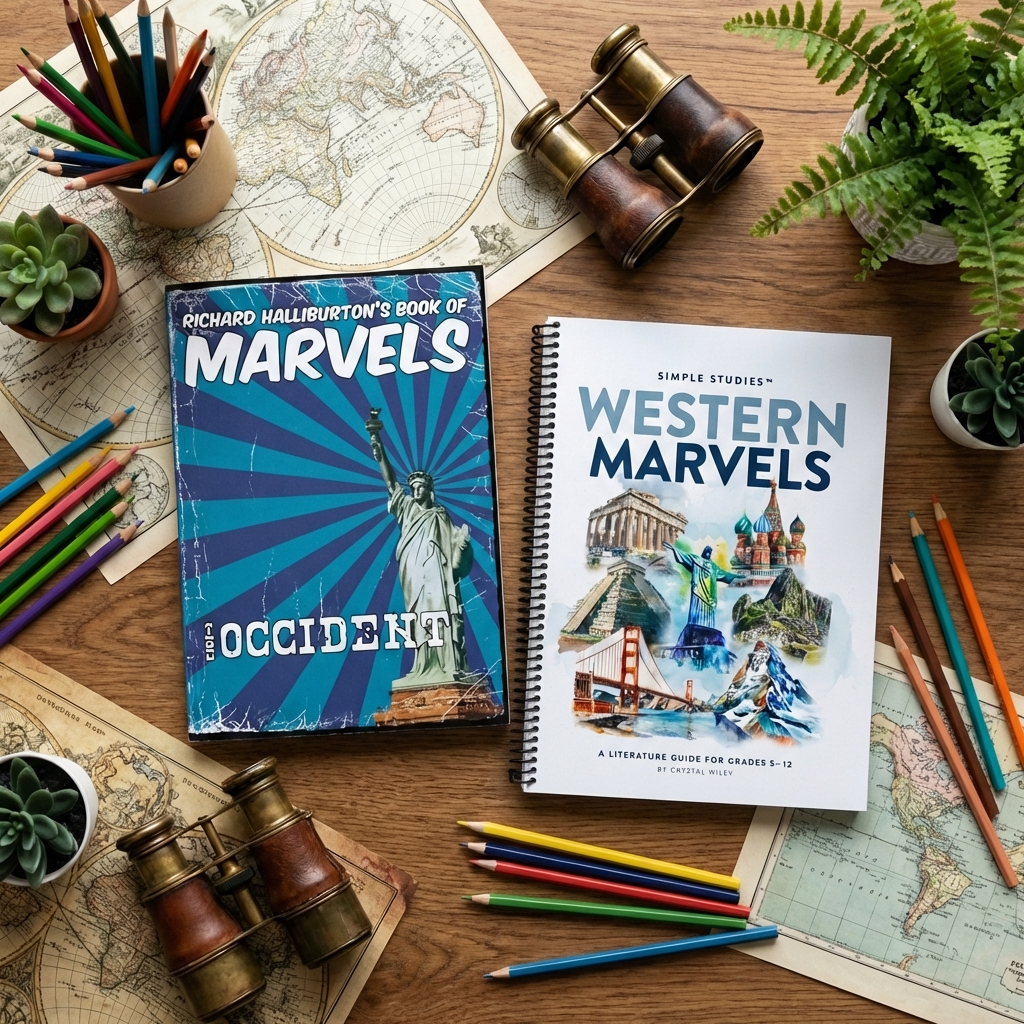
We recently announced our latest new release: Simple Studies: Western Marvels — A Literature Guide for Grades 5–12.

So many of you have pleaded for guides that your middle and high schoolers can use.

I’m reading through Richard Halliburton's Book of Marvels: The Occident a second time around with our youngest, and I created a Simple Studies guide to go alongside it and am sharing it with you, because I know you're also looking for resources that actually meet your kids where these living books take them.
 

Thank you for being here!

Teaching Citizenship with Purpose to All Ages

I received this email recently from a homeschooler: ”Hello!!! I would LOVE and even pay for a beginners guide to teaching citizenship and Plutarch. It feels so overwhelming to me for some reason I don’t even know where to begin, and I saw you mention in one of your videos it’s one of your favorite subjects to teach.” Warm wishes! - KM

I DO love teaching citizenship! But sometimes it sounds intimidating and I can understand why. Public school approaches these topics through subjects like “social studies” and “civics” and when homeschoolers talk about things like Rome and Plutarch and your child is 5 years old… it can feel confusing and overwhelming.

My initial response is to suggest checking out Heroes & Hope and Exploring Political Ideologies for older students, but these are launching pads to dive even deeper and appreciate this subject area.

That’s why today, I’m diving into how we can teach citizenship with purpose to all ages.

Reading through our Heroes & Hope book with my kids in April 2020!

Charlotte Mason viewed citizenship as an essential part of education, helping individuals understand their role and responsibility within society. Her approach was rooted in character formation, moral integrity, and a deep understanding of history, government, and social order.

We also don’t structure our homeschool like a traditional school, with social studies workbooks and tests.

Still, I firmly believe that citizenship encompasses the whole person—their values, beliefs, internal moral compass, and leadership development.

One key aspect I should mention is that I approach citizenship differently with my son and daughter, based on their God-given strengths, skills, and interests. In other words, our son is wired differently than his little sister. Nevertheless, they both deserve exposure to Plutarch, for example. While they may not both be naturally inclined to pursue studies in battle leadership, they are both inclined toward character development and ethics.

Here’s a brief overview of how we’ve approached teaching citizenship over the past 10 years:

  1. Starting in Form 2B (Grade 4): We begin by gradually reading Stories from the History of Rome by Ms. Beesly. The children give an oral or a drawing narration.

  2. Moving to Citizenship Primers: After completing Stories from the History of Rome, we introduce a citizenship primer like The Young Citizen Reader by Paul Reinsch. Alongside this, we start reading through a Plutarch Primer to familiarize the children with the lives and teachings of Plutarch, the Greek historian and biographer. Plutarch's Lives (or Parallel Lives)—biographies of notable Greeks and Romans—are considered foundational in classical education, including in Charlotte Mason's method.

  3. Incorporating Other Stories, Current Events and Guides: While working through the primers, we also explore other historical stories and biographies, using resources like Heroes & Hope, Courage and Exploring Political Ideologies to discuss the ideas and values tied to citizenship. We enjoy poetry like Lyra Heroica, and books like Ourselves and the Socratic Dialogues. There are a plethora of great books depending on what you think your child might enjoy reading and discussing! I offer more ideas in my form guides which you can find here and here.

    We also incorporate daily Current Events (as Charlotte Mason recommends). We’ve been using WORLDWATCH for a couple years and the kids BEG to watch it daily.

    Click Here and use code “CRYSTAL4” for FOUR FREE MONTHS of WORLDWatch for your family.** The deal starts with a free 7 day trial, after this you will be charged $0 for the next 4 months.

  4. Diving Deeper into Plutarch: As we progress, we read Plutarch’s Lives together and discuss the various lives. Initially, my son and I read together, using guides from communities like The CMEC, The Alveary, and Ambleside Online. However, as our schedule became busier and I was reading aloud for most of the day, my son transitioned to online Plutarch classes with a community of students. For the past two years, his favorite has been classes with Thomas Banks from House of Humane Letters.

  5. Engaging in In-Person Discussions on GREAT books: Finally, our kids participate in in-person groups where they get to discuss good books and citizenship values with their peers, focusing on the good, the true, and the beautiful. These can include things like sci-fi or fantasy fiction novels, historical fiction and more.

The key is to not box yourself in! Sure, we can enjoy a path with what others have studied for history AND we can include exciting books and dialogue with others based on modern society and the world we live in and the ideas and challenges we battle today.

In the end, as homeschool parents, our role isn’t to teach everything. It's about exposing our children to a rich feast of ideas and allowing them to explore these topics at their own pace.

I hope this is helpful!